No products in the cart.: $0.00


Facade Lighting Cost Breakdown and Quote Checklist
Facade lighting cost breakdown: what your project quote should include
Facade lighting cost breakdown: what your project quote should include
The cheaper facade lighting quote may leave you with more to buy. Drivers may sit outside the fixture price, and a control system can arrive without programming. Even the installation fee may stop at fixing the lights in place, leaving the final night-time aiming to someone else. A price per luminaire gives you little help with these gaps.
Define which elevations and architectural features are included before counting luminaires.
Start with the finished project
A useful facade lighting budget includes the specified equipment, delivery and destination charges, local installation, access equipment, testing and commissioning. Keep design fees, samples, initial spares and an allowance for unresolved work visible too. Record who pays for each item. A blank cell should mean ‘unconfirmed’, not zero.
Begin with a marked elevation drawing. Is the brief to wash every wall, pick out the columns, trace the roofline, or light just the entrance? Two buildings with the same facade area can have very different equipment schedules. A single cost per square metre hides those differences, much as a room’s floor area tells you little about the cost of its fitted kitchen.
A working budget structure
|
Budget line |
What to include |
What to confirm |
|---|---|---|
|
Luminaires |
Model, quantity, length, optics, colour and finish |
Unit price per piece or per metre; approved specification |
|
Power and controls |
Drivers, control hardware, enclosures and required interfaces |
Included in the fixture price or supplied separately |
|
Mounting and connections |
Brackets, agreed shields, connectors, cables and fixings |
Factory supply versus local contractor supply |
|
Delivery and destination |
Packing, freight, insurance if required, clearance and onward delivery |
Delivery point, responsible party and local charges |
|
Site work |
Labour, access equipment, cable routes and making good |
Local contractor’s scope and access restrictions |
|
Commissioning and handover |
Addressing, scene setup, night aiming, records and training |
Who attends, number of visits and what is handed over |
Assign each cost once. If brackets are already included with a luminaire, record ‘included’ rather than adding another allowance. Ask the local contractor to check cable routes and access before their installation figure becomes part of the approved budget.
Put both quotations on the same basis
Suppose two suppliers quote for the same approved luminaire schedule. The figures below are invented to show the comparison method. They are not Asia Pacific Lighting prices or market estimates, and neither total covers a complete installed project.
Illustrative equipment comparison, USD
|
Same equipment scope |
Quote A |
Quote B |
|---|---|---|
|
Quoted package |
$9,800: luminaires only |
$12,900: listed equipment included |
|
Drivers to add |
$1,800 |
Included |
|
Control hardware to add |
$1,200 |
Included |
|
Brackets to add |
$600 |
Included |
|
Comparable equipment subtotal |
$13,400 |
$12,900 |
Quote A starts $3,100 lower. Once the missing equipment is added, it is $500 higher. Freight, local taxes, installation and commissioning still need separate comparison. A lower subtotal also says nothing about whether the proposed optics, control behaviour or finish meet the specification; settle those differences before choosing on price.
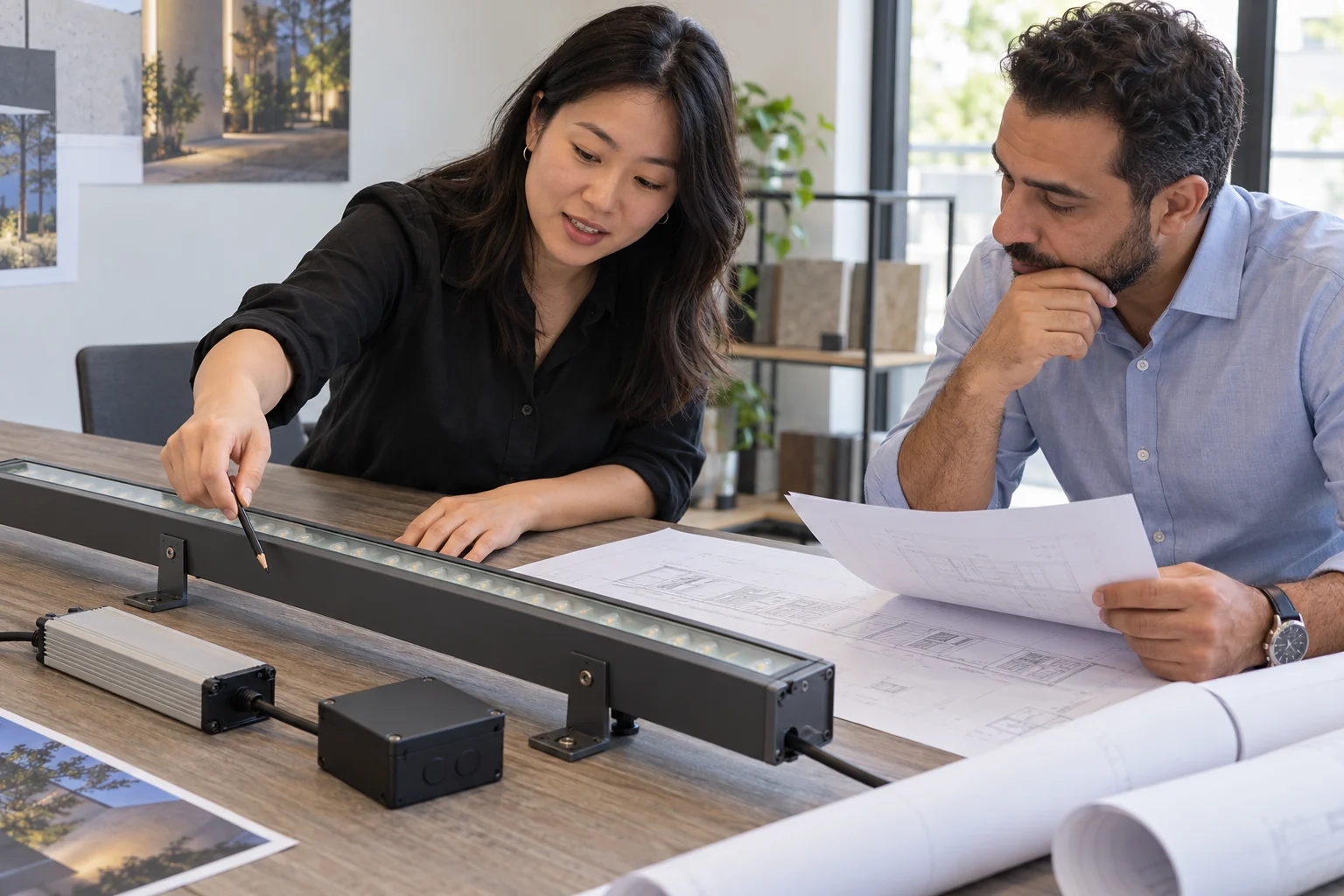
Review the sample with its driver, bracket and control requirements, so the price comparison covers the assembly you will order.
Attach the revision number of the drawing and equipment schedule to every quotation. If a supplier offers an alternative, ask them to identify the changed items beside the base offer. This keeps a shorter fixture, a different optic or a simpler control package from slipping into the comparison unnoticed.
The specification decisions that change the price
Start with the lighting task. A linear product used to trace a cornice has a different job from an outdoor LED wall washer used to illuminate a tall wall. Equal lengths and wattages do not establish an equivalent result. Ask for the photometric file for the proposed configuration and have the designer check it against the mounting position and facade material.
Then settle the light colour and controls. Fixed white, tunable white and RGBW are different specifications. For a controlled installation, name the required protocol and describe the scenes the operator must run. Include addressing, programming and integration responsibilities in the scope. The label ‘DMX compatible’, by itself, does not tell the buyer who will make the finished system work.
Custom lengths, housing colours and cable exits can solve an awkward mounting detail, but they should be priced before the order is fixed. Send the actual detail drawing with your customisation request. Where an international brand or distributor needs private labels, packaging or a particular approval document, list those requirements in the same request. Do not assume that a document for one model covers a modified version.
For an exposed coastal site or a hot enclosure, describe the actual conditions and request evidence for the selected product. A broad regional label such as ‘Middle East project’ is not enough to specify the ambient temperature, exposure or mounting arrangement. Price the confirmed requirements rather than adding every available option.
Allow for getting the lights into place
A luminaire on a ground-floor ledge and the same luminaire above a busy entrance may have the same purchase price. The installation work can be quite different. Ask the contractor about lift access, permitted working hours, temporary barriers and the sequence of other facade work. The cost of returning after the scaffold has gone should be visible before the purchase order is issued.
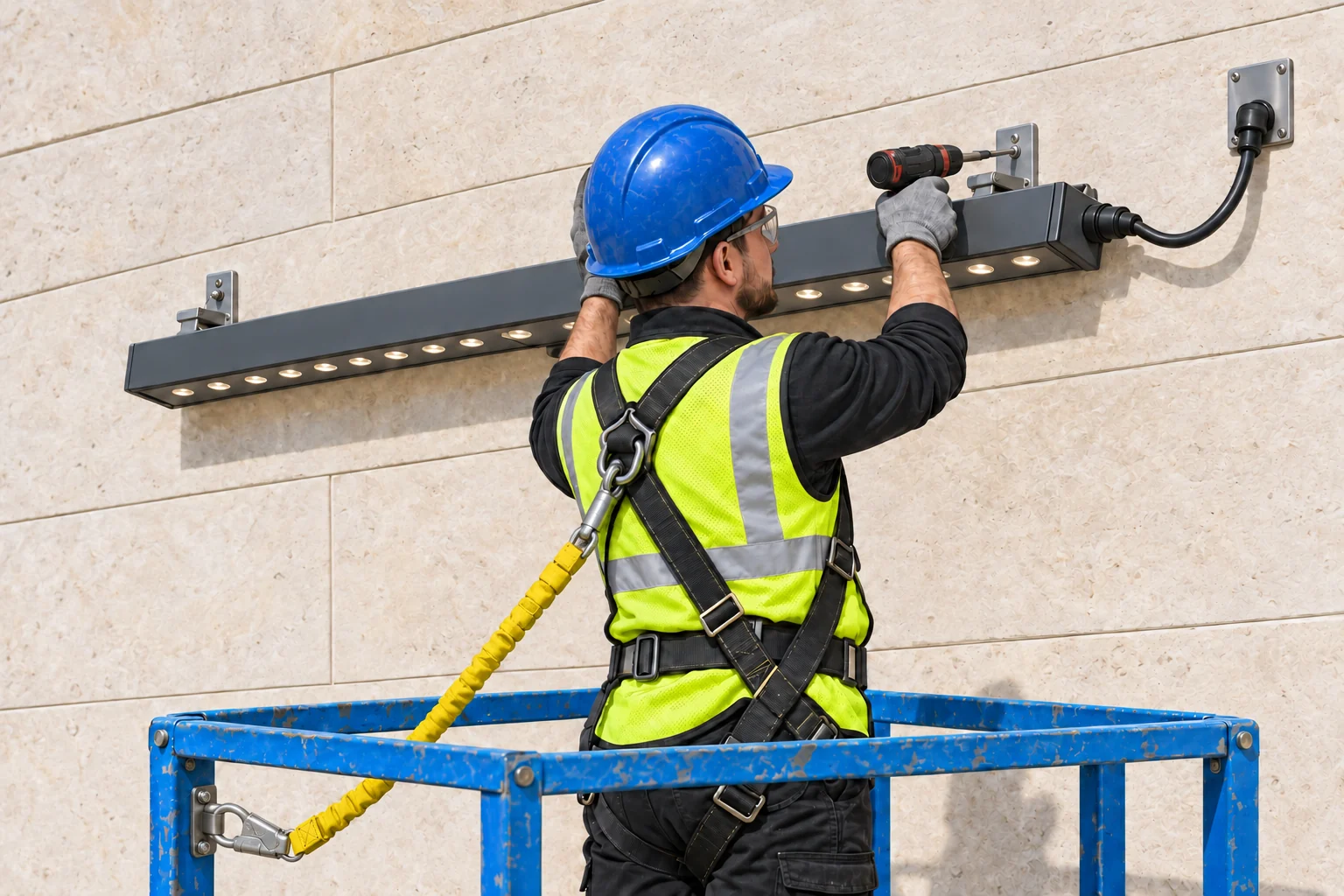
Access equipment and a return visit can change the installed cost even when the luminaire specification stays the same.
For an overseas order, write down the delivery location and ask who arranges each leg of transport. Have the local importing party confirm destination charges and applicable taxes. Keep the currency, quotation validity and payment milestones visible beside the total. These details let a buyer compare offers without silently mixing a factory collection price with delivery to site.
Separate a known expense from a contingency. Extra brackets shown on the drawings are a known expense. A possible change to an unfinished facade detail is an uncertainty. Keep a short register of the unresolved items, assign an owner to each and review the allowance when the detail is agreed.
What to send with a request for quotation
A drawing with a few clear notes is more useful than a long message asking for the best price. Send the project location, marked elevations and dimensions, proposed mounting positions, wall material, required light colour, control brief and delivery date. Add an equipment schedule if one exists; otherwise ask the supplier to state the assumptions behind the proposed quantity.
Please quote against drawing revision ___ and schedule revision ___. Show the luminaire price, included accessories, separate equipment and exclusions. State the delivery point, currency, validity and lead time after approval. Identify who supplies the drivers and controls, who programs the scenes, and whether samples, commissioning support and initial spares are included.
Keep the approved sample and its specification linked to the order. If the layout changes later, update the quantity, accessories and site-work allowance together. Changing only the fixture count leaves the rest of the budget attached to an earlier design.
Questions that come up before ordering
Can I use a price per metre for the first budget?
Yes, for a clearly defined linear lighting run with a stated product configuration. Write down the lengths, gaps, corner details and included accessories. Treat that figure as an early equipment allowance until the mounting and electrical layouts are checked; it is not automatically an installed price per metre.
Where can the budget be reduced without guessing?
Ask the designer to rank the illuminated areas by importance. Price a reduced scope as a separate option, or compare standard lengths with custom lengths where the detail permits. Check a representative sample bay before accepting a changed optic or wider spacing. Record what visual result changes with each saving.
Should spare parts sit inside the purchase budget?
Include the initial spares you agree to buy and identify their models. Decide the quantity with the owner and maintenance team, considering access and replacement lead time. Keep future energy and routine maintenance costs in a separate operating budget so they do not obscure the upfront purchase comparison.
Have a facade drawing ready?
Send Asia Pacific Lighting the marked drawing, destination and control brief through our project enquiry page. Ask for a quotation that separates luminaires, accessories and exclusions. You can also review our linear facade lights while preparing the schedule. Final availability, configuration and commercial terms should be confirmed in the project quotation.
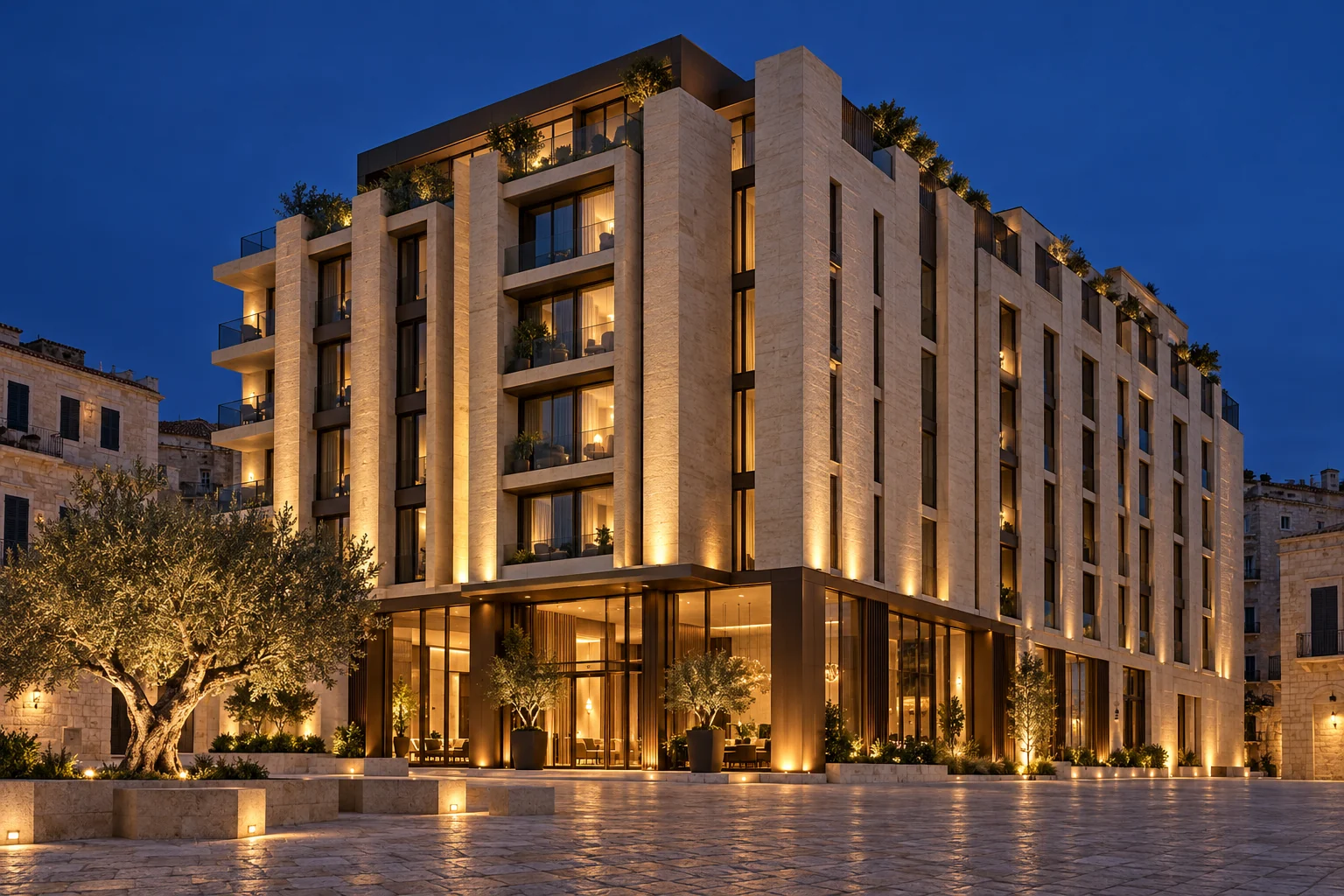
Images are AI-generated illustrations based on photographic references. They do not depict completed Asia Pacific Lighting projects or document measured lighting performance.
For the bigger picture, see our complete guide to facade lighting.