
No products in the cart.: $0.00


Outdoor LED Water Ingress: IP65 vs IP67

Why Outdoor LED Lights Fail from Water Ingress — and How to Prevent It (IP65 vs IP67 Explained)
Quick answer: Most outdoor LED failures caused by water start at the interfaces — gaskets, lens seals, cable glands, and field-assembled connectors — not through the aluminum housing. Moisture corrodes contacts and driver boards, fogs optics, and shortens LED life. Prevent it by matching the IP rating to the worst site water condition, using matched waterproof connectors, installing with drip loops and correct gland torque, and testing a first-article install before full rollout.
Outdoor architectural lighting lives in rain, wind-driven spray, coastal salt air, freeze–thaw cycles, and — on many projects — poor drainage. When outdoor LED fixtures — wall washers, linear facade lights, flood lights, or in-ground lights — fail prematurely, water ingress is one of the common causes worth investigating. Moisture reaches the LED board, driver, or optics, and performance drops long before the LEDs themselves reach end of life.
This guide is for lighting designers, electrical contractors, building owners, and distributors working on facade, bridge, plaza, hospitality, and landscape projects in North America, Europe, the Middle East, and Southeast Asia. It covers:
Why water kills outdoor LEDs, and how to read the symptoms on site
Where fixtures actually leak
What IP65, IP66, IP67, and IP68 really test — and what they don’t
Design, installation, and testing practices that prevent failures
A buyer checklist and the questions to ask your supplier
Why water ingress kills outdoor LEDs
Water does not need to flood a fixture to destroy it. A thin film of moisture, repeated condensation cycles, or capillary wicking along a cable jacket is enough.
1. Corrosion of electronics and contacts. Moisture and oxygen — plus salt on coastal sites from Florida and the Gulf Coast to the Arabian Gulf — corrode solder joints, LED pads, driver components, and connector pins. Resistance rises, current becomes unstable, and channels flicker or die one by one.
2. Short circuits and insulation breakdown. Water bridging conductors can trip GFCI/RCD protection, damage drivers, or create intermittent faults that are hard to trace on long power and DMX runs across a facade.
3. Optical degradation and component damage. Fogged lenses cut output and ruin wall-wash uniformity. Moisture can also accelerate corrosion, degrade electrical insulation, and damage electronic components. These effects can reduce fixture reliability and lead to premature failure.
4. Progressive, not overnight, failure. Many “waterproof” failures start small: a soft seal, an under-tightened gland, a connector left without gel. Water enters, evaporates, and leaves residue. Months later the fixture fails — usually after handover, when warranty cost and reputation are on the line.
Whether it is freeze–thaw in Chicago or Toronto, monsoon humidity in Singapore, or salt spray in Dubai, the physics is the same: ingress + time = early failure.
Diagnose it on site: symptom → likely cause
|
Symptom on site |
Likely water-related cause |
First thing to check |
|---|---|---|
|
Fog or droplets inside the lens |
Condensation from thermal “breathing” or a lens-seal gap |
Lens gasket seating; vent or membrane blocked |
|
One section of a linear run dark or flickering |
Corroded or poorly mated inter-fixture connector |
Connector pins for green or white residue; locking ring engaged |
|
Breaker or GFCI trips after rain |
Water bridging conductors at a junction or driver |
Junction boxes, cable glands, driver compartment |
|
Color shift or dim patches along a wall wash |
Moisture film on optics or corroded LED pads |
Inside of glass; LED board for discoloration |
|
Whole fixture dead, driver smells burnt |
Water pooled on driver cover or entered cable entry |
Mounting orientation; drip loop; gland size vs cable OD |
|
Failures cluster at ground level or planter edges |
Standing water exceeding the fixture’s IP rating |
Drainage; whether IP67-class product was needed |
Where water really gets in: 6 common failure points
An IP rating describes a new enclosure tested under defined conditions. On a real project, water almost always enters at interfaces — not through solid aluminum.
1. Gaskets, lens seals, and end caps
Silicone and rubber gaskets age under UV, ozone, and compression set. Over-tightened screws squeeze a gasket out of its groove; under-tightened screws leave a gap. End caps on linear facade lights and wall washers leak when the seal face is dirty, scratched, or misaligned during assembly or field service.
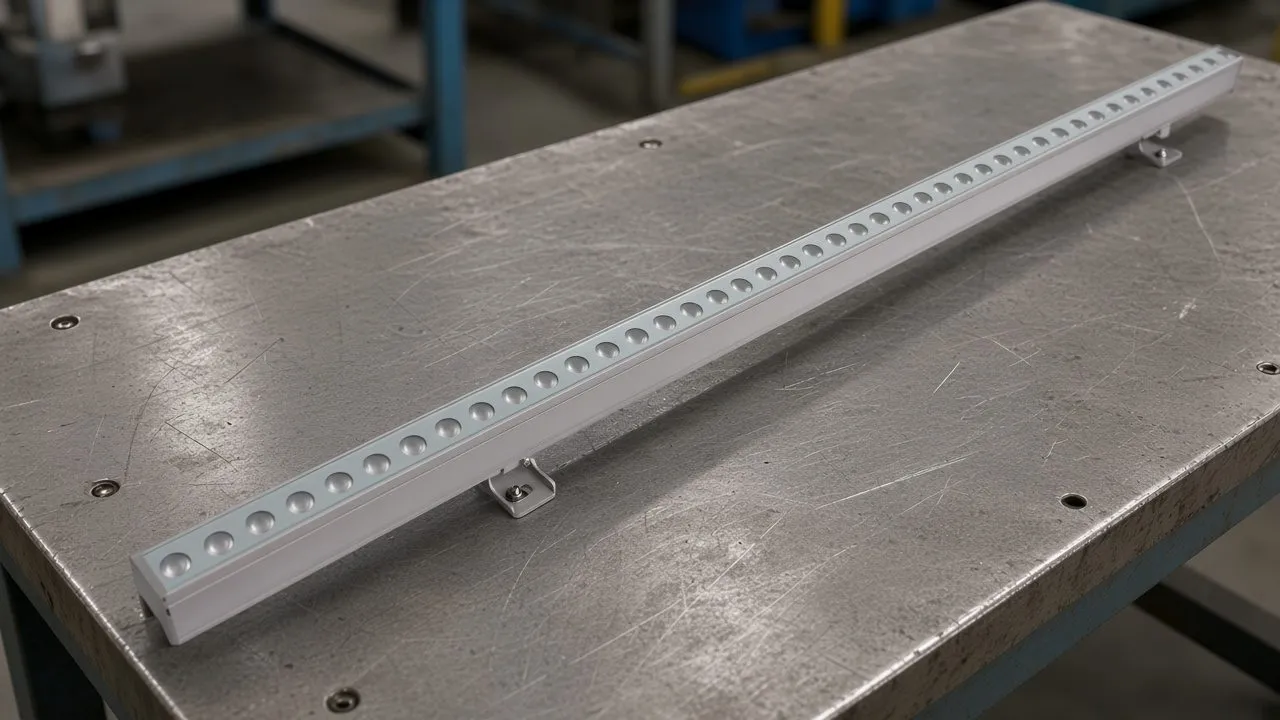
2. Connectors between fixtures
On continuous linear runs and daisy-chained wall washers, water usually enters at the inter-fixture connector, not the body. If the IP claim covers the housing but the joint is assembled incorrectly in the field, the system is only as waterproof as its weakest connection. Captured gasket grooves, positive locking, and matched male/female connectors matter more than marketing copy.

3. Cable glands and cable entry
A cable gland must match the cable’s outer diameter. The wrong size, a missing washer, or incomplete tightening creates a capillary path along the jacket. Sharp bends at the gland, or cables pulled by wind load, open the seal over time.
4. Driver and power compartment
Drivers run warm inside sealed volumes. If the compartment seal fails — or the fixture is mounted so water pools against the cover — the electronics fail first. Where the design allows, separate optical and electrical compartments can help reduce the risk of moisture reaching the driver if the optical compartment develops a leak.
5. Condensation and “breathing”
Fixtures heat up when on and cool when off. The pressure change pulls moist air in through micro-gaps; as the fixture cools, it condenses on cold glass and boards. This is common on humid nights in Southeast Asia and the US Southeast, and in spring and fall when day–night swings are large. Without a pressure-equalizing membrane vent (where the design calls for one) or protective potting, a fixture can “sweat” without ever sitting in a puddle.
6. Over-claimed or misunderstood IP ratings
A fixture labeled IP65 is not automatically suitable for ground-level flooding, poorly drained planter edges, or coastal wave splash. Claiming a rating without testing the full assembly — housing, glass, gasket, gland, and connector as installed — is a common industry risk that buyers should challenge.
IP65 vs IP66 vs IP67 vs IP68: what the tests actually mean
IP ratings are defined by IEC 60529. The first digit is dust protection (6 = dust-tight); the second is water protection.
|
Rating |
Water test (IEC 60529, summarized) |
What it means in practice |
|---|---|---|
|
IP65 |
Water jets from a 6.3 mm nozzle, about 12.5 L/min, from all directions |
Rain and hose-down; fine for elevated, well-drained facades |
|
IP66 |
Powerful jets from a 12.5 mm nozzle, about 100 L/min |
Wind-driven rain, exposed plazas, rooftops, washdown |
|
IP67 |
Temporary immersion, 1 m depth for 30 minutes |
Occasional standing water; ground-adjacent mounts |
|
IP68 |
Continuous immersion beyond 1 m, conditions declared by the manufacturer |
Fountains, pools, in-ground in wet pits — check the stated depth and duration |
Two points buyers often miss. First, a higher digit is not a superset: an IP67 immersion test does not prove resistance to IP66 jets, which is why quality products are marked “IP66/IP67” when tested for both. Second, IP tests are short and done on new samples; they say nothing about UV aging, thermal cycling, or salt corrosion over five years.
For North American projects: specifiers usually also require a UL or ETL listing for wet locations (luminaires per UL 1598). Wet-location listing and IP rating are separate — ask for both where the project needs them.
How to prevent water ingress failures
Prevention is a chain: product design → correct IP selection → installation quality → drainage and mounting → verification testing. A break at any link undoes the rest.
Step 1: Choose a fixture designed as a waterproof system
Ask how waterproofing is achieved, not just which IP number is printed. Look for:
Continuous seal grooves with controlled gasket compression
Glass-to-housing sealing (gasket and/or structural sealant) tested as an assembly
Waterproof, positively locking connectors rated for outdoor daisy-chain runs
Correctly sized cable glands with strain relief
Potting, gel filling, or conformal coating on critical electronics where the design uses them
Corrosion-resistant finishes and stainless hardware for coastal and high-UV sites
Separate optical and electrical compartments where relevant
Factories that treat waterproofing as a system — structure, connectors, potting, and lab testing — are better placed to deliver stable outdoor results than those that only print an IP code on the carton.
Step 2: Match the IP level to the worst site condition
|
Application |
Recommended protection |
|---|---|
|
Elevated facade wall washers and linear accents, good drainage |
IP65–IP66, with seals and connectors installed correctly |
|
Heavy rain, wind-driven spray, exposed plazas, rooftops |
IP66 or higher, with robust connector design |
|
Ground-adjacent, planter edges, occasional standing water |
IP67-class (ideally IP66/IP67), mounted to avoid pooling |
|
Fountains, pools, prolonged immersion |
IP68 at the manufacturer’s stated depth — never a facade product |
Specify the whole assembly — fixture, connectors, and glands — for the worst credible water exposure on site, not the average day.
A note on IP67: IP67 should not be treated as approval for permanent underwater installation. Always verify the tested configuration, immersion conditions, and the rating of all external connections. For ground-level and in-ground locations, also check:
The fixture’s actual installed depth relative to likely water levels
How long water may stand around the fixture after heavy rain
Whether cable entries and connectors were included in the immersion test
Whether the fixture passed both IP66 jet and IP67 immersion tests
Whether the mounting structure or pit can drain
Planning a facade or landscape project? Send us your mounting details and site conditions for a free project consultation. Our engineers will recommend the IP level, connector type, and finish for each fixture location. Get your free project consultation →
Step 3: Install it right
A well-designed luminaire still fails if installed poorly:
Keep seal faces clean; never nick gaskets when opening a fixture.
Use only the manufacturer’s matched waterproof connectors; don’t mix brands.
Tighten glands and connector locks to the specified torque — don’t over-crush seals.
Leave a drip loop on every cable so water runs away from the gland.
Keep fixtures out of stagnant water; adjust brackets or heights where a detail pools rain.
Seal building penetrations separately — the fixture’s IP rating does not waterproof the hole in the wall.
On coastal projects, follow the specified stainless hardware and coating-care guidance.
Step 4: Get drainage, orientation, and venting right
Mount so water sheds off covers rather than sitting on them. Avoid upward-facing openings unless the product is designed for that orientation — many flood lights and wall washers are orientation-sensitive. Never paint over or block pressure-equalizing vents. For in-ground fixtures, a drained mounting pit (gravel bed or drain connection) matters as much as the IP rating.

Step 5: Test before mass installation
On project-critical runs, sample testing pays for itself:
Visual and torque checks on seals and connectors
Spray or immersion testing consistent with the claimed IP rating, in a lab or controlled on-site method
A first-article install reviewed with the lighting contractor before full facade rollout

7 questions to ask your outdoor LED supplier
A capable manufacturer answers these in specifics, not slogans:
How was the IP rating verified on the complete assembly, including connectors and glands?
Which gasket material is used, and how is compression controlled?
What connector system is used between fixtures, and what is its own IP rating?
Which electronics are potted, gel-filled, or conformally coated?
How does the fixture manage condensation — sealed, potted, or vented with a membrane?
What finish and hardware do you recommend for coastal or high-salt sites?
What installation guidance and spare parts (gaskets, connectors) do you supply with the order?
Buyer checklist: reduce water risk on your next project
IP rating matches the worst site water condition, not the brochure highlight
Supplier has explained seal design, connector type, gland sizing, and potting approach
Connector IP rating and assembly method are specified for continuous linear runs
Glass and lens sealing is tested as a full assembly
Wet-location listing (UL/ETL) confirmed where required
Mounting details avoid pooling; in-ground pits are drained
Drip loops and penetration sealing are in the install method statement
Coastal projects specify corrosion-suitable finish and hardware
Sample or first-article waterproof check is done before full installation
Spare gaskets, connectors, and an after-sales contact are agreed

Get a free project consultation for your next outdoor lighting project
Asia Pacific Lighting (LJM Lighting) manufactures outdoor architectural LED lighting — LED wall washers, linear facade lights, flood lights, in-ground lights, and related outdoor luminaires — with sealed structures, outdoor-rated waterproof connectors, protective potting where applicable, and waterproof testing. Our fixtures use MEAN WELL drivers, and every fixture goes through burn-in testing before shipment — typically 24 to 48 hours for production orders, and longer for samples and custom builds.
For facade, bridge, plaza, hospitality, villa, or landscape projects, send us:
Drawings or elevations showing fixture locations
Mounting details (wall, parapet, ground, planter)
Climate and exposure (coastal, freeze–thaw, heavy rain, standing water)
Control requirements (on/off, 0–10V, DALI, DMX)
Our engineers will reply with recommended fixture types, IP levels, and connector and finish options matched to your real site — not just the catalog line.
Book your free project consultation → · Samples available for replacement and retrofit projects.
Related reading: LED wall washers for outdoor facades · Linear LED facade lights · Choosing the best IK rating for outdoor lighting · LED lifetime: maximizing lifespan
FAQ
What usually causes outdoor LED lights to fail from water?
Most failures start at seals, connectors, cable glands, or driver covers rather than the metal housing. Condensation from temperature cycling and overstated IP ratings also contribute.
Is IP65 enough for building facade lighting?
Often yes, for elevated wall washers and linear lights with good drainage and correctly installed connectors. Exposed plazas, wind-driven rain, ground-level mounts, or coastal splash call for IP66 or IP67-class products.
What is the difference between IP65 and IP67?
IP65 is tested against low-pressure water jets; IP67 is tested for temporary immersion at 1 m for 30 minutes. Choose IP67 where water can collect around the fixture, and IP66/IP67 where both jets and pooling are possible.
Is IP68 better than IP67 for outdoor lighting?
Not automatically. IP68 means continuous immersion under conditions the manufacturer declares. It is essential for underwater and fountain lights, but it does not replace jet resistance for facade fixtures.
Why do “waterproof” fixtures fog up inside?
Heating and cooling change internal pressure and can draw moist air through micro-gaps, which then condenses on cold glass. Good sealing, potting, or a pressure-equalizing membrane vent reduces this.
Do outdoor LED lights need a wet-location rating in the US?
Yes, fixtures exposed to rain are generally required to be listed for wet locations under the electrical code. Confirm both the UL/ETL wet-location listing and the IP rating on the specification.
How can contractors reduce water ingress on site?
Use matched waterproof connectors, correctly sized and tightened glands, clean gasket seats, drip loops, and mounting that sheds water. Verify a first-article install before rolling out an entire facade or bridge run.


