No products in the cart.: $0.00


Wall Washer Distance from Wall: Set-Back Guide

Wall Washer Distance from Wall: A Set-Back and Spacing Guide
Quick answer: For Asia Pacific Lighting outdoor linear wall washers mounted at the base of a facade, the fixture typically sits about 15 cm (6 in) from the wall. Instead of moving the fixture further away for taller walls, we choose a narrower or asymmetric beam and tilt the fixture toward the wall. Placing a narrow-beam fixture much further out leaves a dark band at the bottom of the wall and raises the risk of glare. Every project is different, so confirm the distance with a short night mock-up.
Distance from the wall is one of the cheapest things to get right and one of the most expensive to fix once brackets are fixed and cables are sealed. This guide explains how set-back works, shows the set-up we typically use and explains how to check it on site. For a broader introduction, see our complete guide to LED wall washer lights.
Quick guide: wall washer distance from wall
Our linear wall washers typically sit about 15 cm (6 in) from the wall surface.
Match the beam angle and tilt to the wall height, rather than moving the fixture further away.
A narrow beam placed far from the wall leaves a dark band at the base.
Install linear wall washers end to end, with no gaps.
Confirm with a night mock-up; some projects need a different distance.
Why the distance from the wall matters
Set too far out. The beam meets the wall higher up, leaving a dark band at the base. More light spills past the wall, and the fixture is more likely to be seen directly by people walking past.
Wrong beam for the distance. A wide beam close to the wall can create a hot spot at the base and spread too little light to the top of a tall wall.
About right. The beam meets the wall close to its base and spreads evenly upward, with no hot spot and no dark band.
How set-back and beam angle work together
Set-back is the horizontal distance from the wall surface to the centre of the fixture’s lens. Picture a wall washer on the ground, aimed straight up at that distance from the wall. The edge of its beam leans toward the wall at half the beam angle. The point where that edge reaches the wall is roughly:
Height where the beam meets the wall ≈ set-back distance ÷ tan(beam angle ÷ 2)
Everything below that height is outside the main beam, so it looks noticeably darker. The table shows how quickly that dark band grows as the fixture moves away from the wall, especially with narrow beams:
| Set-back from wall | 15° beam | 30° beam | 60° beam |
|---|---|---|---|
| 10 cm (4 in) | 0.76 m (2.5 ft) | 0.37 m (1.2 ft) | 0.17 m (0.6 ft) |
| 15 cm (6 in) | 1.1 m (3.7 ft) | 0.56 m (1.8 ft) | 0.26 m (0.9 ft) |
| 30 cm (12 in) | 2.3 m (7.5 ft) | 1.1 m (3.7 ft) | 0.52 m (1.7 ft) |
| 50 cm (20 in) | 3.8 m (12.5 ft) | 1.9 m (6.1 ft) | 0.87 m (2.8 ft) |
Approximate height of the darker band at the base of the wall for a fixture aimed straight up. Beam angle is measured at 50% intensity, so some light still reaches the band; tilting the fixture toward the wall reduces it.
Two practical lessons follow:
Keep the fixture close and let the optics do the work. At about 15 cm, even a 30° beam meets the wall around half a metre up, and a small tilt brings it lower. That is why we usually keep our linear wall washers close to the wall.
Moving a narrow beam further out makes things worse, not better. A 15° wall washer placed 50 cm from the wall and aimed straight up leaves almost 4 m of wall in relative shadow.
For choosing the beam itself, see our guide to choosing wall washer sizes and beam angles for each project.
Typical set-up by wall height
| Wall height | Typical beam | Distance from wall | Aiming |
|---|---|---|---|
| Up to 3 m (10 ft) | 30°–60° | About 15 cm (6 in) | Usually aimed straight up |
| 3–8 m (10–26 ft) | 15°–30° or asymmetric | About 15 cm (6 in) | Tilt toward the wall during night aiming |
| Above 8 m (26 ft) | 10°–15° or asymmetric (e.g. 10°×60°) | About 15 cm (6 in) as a starting point | Tilt toward the wall; consider a second row higher up |
This is the set-up we typically use for our linear wall washers, not a fixed rule. Some projects need a different distance, for example where a kerb, planter or drainage channel sits at the base of the wall, where the fixture must hide behind a parapet, or where the wall surface is very dark or highly textured. We work these out case by case, usually with a mock-up.
Tilt, spacing and grazing
1. Tilt and asymmetric optics
Most outdoor wall washers sit on adjustable brackets. Tilting the fixture toward the wall lowers the point where the beam meets it, which shrinks the dark band without moving the bracket. Set the final angle during night aiming, not from the drawing.
Asymmetric and elliptical lenses (for example 10°×60° or 15°×35°) are designed for exactly this problem: they push light up the wall while spreading it sideways, so the fixture can stay close to the wall and still light the whole height. If the bracket position is fixed by the architecture and the result shows a bright base and dark top, read what to do when your wall washer bracket is too low.
2. Spacing between fixtures
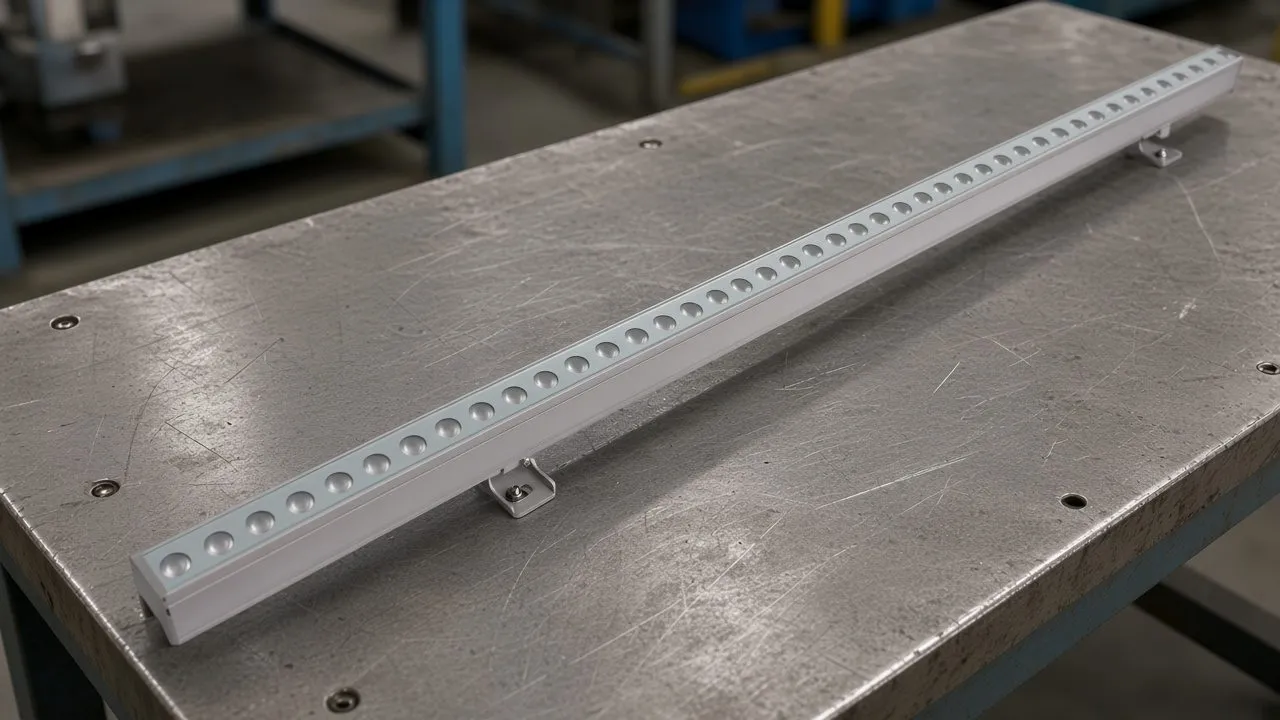
Linear wall washers: install them end to end in a continuous run. Gaps between bodies show up as dark stripes on the wall, especially with narrow beams.
Individual (point-type) wall washers: as a starting point, space them at about the same distance as their set-back from the wall, then check for scalloping in a mock-up.
Corners and ends: stop a run slightly short of a corner, or the beam will spill around it onto the return wall.
3. Washing vs grazing
Washing and grazing are decided by the optics and aiming as much as by the distance. A wall washer spreads light evenly to hide surface texture; a grazer uses a very narrow beam aimed to skim almost parallel to the surface, which brings out the texture of stone, brick or ribbed panels. On smooth materials such as render, glass or metal panels, grazing exaggerates every imperfection, so a wall washing set-up is usually better. See wall grazer vs wall washer for the full comparison.
4. Wall washers mounted at the top of the wall
The same geometry applies upside down. A fixture mounted under a parapet or canopy and aimed downward leaves a darker band just below it if it projects too far from the wall. Top-mounted wall washers also need more attention to glare from windows and balconies above. Our guide to outdoor wall washer glare control covers the checks to make.

How to check the distance on site
Mock up one bay at night. Install two or three fixtures on temporary brackets at the planned distance, typically about 15 cm from the wall.
Try small changes. Compare the planned set-up with a few centimetres closer or further away, and with a slight tilt toward the wall.
Look from where people will see it. Check from the street, the main approach and any windows that face the facade.
Check the base and the top. Look for a hot spot or dark band at the bottom and enough light at the top.
Record the result. Note the final distance, tilt and beam so the installer can repeat it on every bay.
For the full sequence from survey to commissioning, see our outdoor wall washer installation guide.
Common mistakes
Moving a narrow-beam fixture far from the wall instead of tilting it or changing the beam
Setting the distance from the drawing alone, without a night mock-up
Leaving gaps between linear fixtures to save cost
Placing brackets where water collects at the base of the wall
Using a grazing set-up on a smooth facade that shows every flaw
Frequently asked questions
How far should a wall washer be from the wall?
For Asia Pacific Lighting linear wall washers mounted at the base of a facade, about 15 cm (6 in) from the wall is typical. Taller walls are handled with narrower or asymmetric beams and a slight tilt rather than a larger distance. Some projects need a different set-back, so confirm it with a mock-up.
How is the distance from the wall measured?
It is the horizontal distance from the wall surface to the centre of the fixture’s lens.
Why is the bottom of my wall dark?
The fixture is probably too far from the wall for its beam angle, or aimed straight up. Move it closer, tilt it toward the wall, or switch to an asymmetric or wider beam.
How far apart should wall washers be spaced?
Linear wall washers are normally installed end to end with no gaps. For individual wall washers, start with spacing roughly equal to the set-back distance and confirm with a mock-up.
Is there a formula for wall washer distance?
A quick check is: height where the beam meets the wall ≈ set-back ÷ tan(beam angle ÷ 2), for a fixture aimed straight up. It is a guide only; tilt, lens design and the wall surface all change the result.